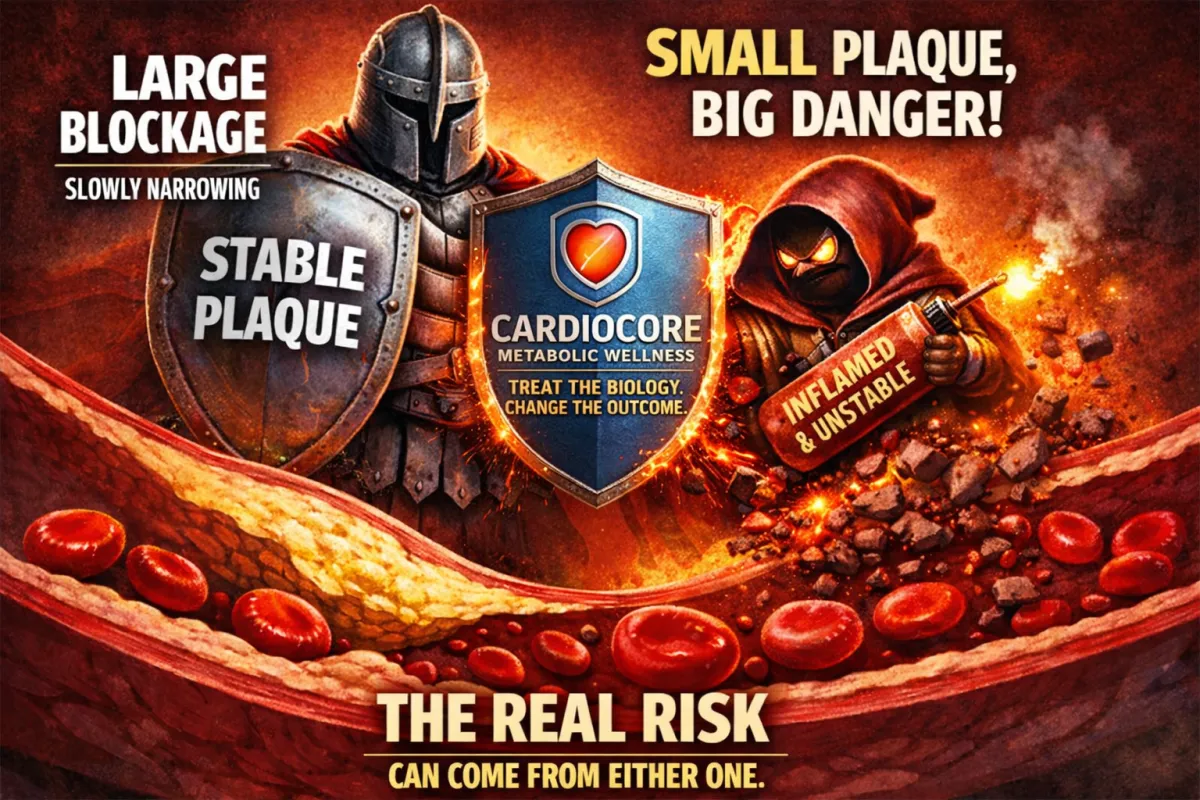
Why “Mild” Heart Disease Is Often Anything But Mild
Mild Blockages Can Still Cause Major Heart Attacks
How inflammation and metabolic disease drive plaque rupture long before arteries look “severely blocked”
John Sciales, M.D.
Director, CardioCore Metabolic Wellness Center
“Getting to the Core… the Path to Wellness — where being Healthy is Not an Accident.”
Summary:
Why “Mild” Heart Disease Is Often Anything But Mild
Most people believe heart attacks happen only when an artery becomes badly blocked. If a doctor says, “You only have mild narrowing,” patients often feel relieved and assume their risk is low. But modern cardiology has shown that this belief is dangerously misleading. In reality, most heart attacks come from plaques that were not severely blocking blood flow before they suddenly ruptured. It is not just how narrow an artery looks that matters, it is how inflamed, unstable, and biologically active the plaque has become.
This is why so many people suffer heart attacks, strokes, or sudden cardiac death after being told their stress test was normal, their cholesterol looked fine, or their blockages were “not bad enough to treat.” These events are later labeled “unexpected,” but from a cardiometabolic perspective, they are often the predictable result of untreated inflammation, insulin resistance, and metabolic dysfunction inside the artery wall.
If you have been told you have:
a high coronary calcium score
plaque on a coronary CT angiogram (CTA)
“mild” blockages
or early heart disease with normal or borderline cholesterol
then this article is written for you.
It explains why small plaques can be far more dangerous than large stable ones, why cholesterol numbers alone do not tell the full story, and why focusing only on whether you need a stent misses the most important opportunity in prevention, treating the biological terrain that drives plaque instability in the first place.
Heart disease is not just a plumbing problem.
It is a metabolic and inflammatory disease of the entire vascular system.
And that matters not only for your heart, but also for your risk of:
fatty liver disease, kidney disease, cognitive decline, chronic fatigue, and even certain cancers, all of which share the same underlying metabolic drivers.
If you or someone you love has evidence of atherosclerosis, this is not the time for reassurance based on “acceptable numbers.” It is the time for deeper understanding and more intentional prevention.
Because the goal is not to survive your first heart attack.
The goal is to prevent it from ever happening.
The Dangerous Myth of the “Clogged Pipe”
Most people believe heart attacks happen when an artery becomes very narrow and finally “clogs.”
That story feels logical, simple, and reassuring. If doctors can measure how tight a blockage is, then danger must be easy to spot. But modern cardiovascular science has shown that this idea is often wrong.
Many heart attacks do not come from the tightest blockages. In fact, multiple studies show that about two-thirds of heart attacks are caused by plaques that were less than 50% narrowed before they suddenly ruptured and formed a clot [1–4]. This means a person can be told they have only “mild” blockages and still be at serious risk for a sudden heart attack, stroke, or even sudden cardiac death.
This misunderstanding creates one of the most dangerous sentences in cardiology:
“That’s not bad enough to need a stent.”
While that statement may be true from a mechanical point of view, it does not mean the person is safe. A stent is designed to fix blood flow when an artery is severely narrowed. It does not predict whether a plaque is biologically unstable and ready to rupture. Flow problems and rupture risk are not the same thing, yet they are often confused in everyday medical conversations.
What Actually Causes Heart Attacks
To understand why small blockages can be so dangerous, we need to understand what actually causes heart attacks.
A heart attack usually does not happen because an artery slowly closes like a rusty pipe. Instead, it happens when a plaque inside the artery wall becomes inflamed, fragile, and breaks open. When that surface ruptures, the body forms a clot to “heal” the injury. Unfortunately, that clot can suddenly block the artery completely, cutting off blood flow to the heart muscle.
An artery can go from 30–50% blocked to 100% blocked in minutes. This is why heart attacks are often sudden and labeled “unexpected.” The danger is not only how narrow the artery looks, but how unstable the plaque has become [2–5].
This is also why many people with “mild” blockages still suffer major events. It is not the size of the bump that matters most. It is whether the surface is cracked, inflamed, and biologically active.
Why Stress Tests Often Miss Risk
This biology also explains why stress tests can be falsely reassuring.
Stress tests mainly look for reduced blood flow during exercise. They do not see plaque inside the artery wall, and they cannot tell whether plaque is inflamed or vulnerable to rupture. A person can pass a stress test and still have large amounts of plaque quietly building and destabilizing inside the vessel wall. Stress tests look for ‘rate limiting flow’ and not for evidence of atherosclerosis which is the build up of plaque.
This is not a rare scenario. It is common in people with insulin resistance, metabolic syndrome, inflammation, and diffuse plaque patterns, exactly the patients most likely to suffer plaque rupture rather than slow blockage progression [6–8].
Tim Russert: A Tragic and Powerful Example
A well-known example of this biology is Tim Russert, the longtime moderator of NBC’s Meet the Press. He died suddenly at age 58. Public reports stated that just six weeks earlier he had a normal stress test and an LDL cholesterol below 70 mg/dL. Yet he died from rupture of an unstable coronary plaque that caused a fatal heart attack [9–11].
His story reflects what cardiologists now clearly understand ;
“Normal” stress tests and “good cholesterol” do not guarantee protection from plaque rupture.
His death was NOT caused by a slowly closing artery. It was caused by unstable inflammatory plaque.
And this is the part that should haunt every clinician and every healthcare system. No physician ever wants to sit across from a spouse or a child and say, “We told him he was fine. We told him his tests looked good. We reassured him. And we were wrong.”
No family should ever have to hear that their loved one’s death was labeled “unexpected” simply because the wrong markers were followed and the deeper disease biology was never addressed. When reassurance replaces real prevention, the cost is not just statistics. The cost is human life, and families left with questions that can never be answered. And in the long run, it is not the cardiologist who lives with that loss every day. It is the wife or husband who goes home to an empty house. It is the children who grow up without a parent. It is the loved ones who carry the weight of that absence for the rest of their lives. This is not something that can be shrugged off as bad luck or dismissed as an “unpredictable” event. When warning signs were present and deeper biology was not addressed, these outcomes are not just tragic, gthey are preventable. And prevention is a responsibility we all share.
Direct Coronary Imaging: Why Calcium Changes the Conversation
This brings us to one of the most powerful tools in modern prevention: the coronary artery calcium score (CAC).
The calcium score does not measure how narrow one spot is. It measures how much calcified plaque exists throughout the coronary arteries. In other words, it measures total plaque burden, not just a single pinch point.
Calcium is not the beginning of plaque. It usually appears after years of inflammation, lipid accumulation, immune activation, and failed repairinside the artery wall. When calcium appears, it means the disease process has already been active for a long time [12–15].
Coronary CT angiography (CTA) goes even further by using contrast to visualize both calcified and non-calcified plaque, assess plaque composition, and estimate narrowing. It shows not just where plaque exists, but how biologically active it may be.
Clinically, a calcium score above 300 is considered high plaque burden and is strongly associated with increased risk of heart attack and cardiovascular death. At this level, plaque is rarely limited to one small spot. It usually reflects diffuse disease affecting the entire coronary tree.
Calcium does not form in healthy arteries. It is a biological marker of long-standing metabolic and inflammatory injury. When clinicians treat calcium findings only as a reason to consider stents, they miss the far more important message: the entire artery wall is diseased.
The LDL Paradox: When “Good Numbers” Hide Dangerous Disease
This leads to one of the most confusing and dangerous paradoxes in cardiology: many people with high calcium scores and diffuse plaque also have low or normal LDL cholesterol.
This surprises both patients and clinicians who were trained to think of cholesterol as the primary cause of plaque. When LDL is not very high, some clinicians assume risk must be low and respond with low-dose statin therapy “just to be safe.” Unfortunately, this approach often misses the true biology of the disease.
In many of these patients, plaque is not driven by LDL alone. It is driven by a pro-inflammatory, insulin-resistant metabolic environment. High insulin levels, oxidative stress, abnormal immune signaling, endothelial dysfunction, and poor metabolic flexibility all damage the artery wall and promote plaque instability, even when LDL looks acceptable [16–18].
In this setting, low LDL does not mean low risk. It often means the disease is being driven by forces that cholesterol tests do not capture.
Statins are often described as cholesterol drugs, but that is only part of their action. Statins also reduce inflammation and stabilize plaque. However, these benefits are dose-dependent. Low-intensity statins do not reliably provide the same plaque-stabilizing protection as moderate- or high-intensity therapy [19–21].
This is why more than 70% of patients admitted with heart attacks have LDL levels that would not previously have labeled them “high risk”[22–24].
As Albert Einstein famously said:
“Not everything that can be measured counts, and not everything that counts can be measured.”
Once coronary disease is present, cholesterol numbers become weaker predictors of events than plaque burden, inflammation, insulin resistance, and vascular biology.
Beyond Cholesterol: Why Metabolic Testing Matters in Coronary Disease
Another major failure in modern prevention is the lack of serious metabolic testing in patients with coronary disease.
Many patients are told they do not have diabetes because fasting glucose or A1c looks normal. But these tests often miss early insulin resistance and abnormal glucose handling, which may be present for many years before diabetes is diagnosed.
What is especially troubling is that this is not alternative medicine. It comes directly from cardiology research.
In 2013, investigators in The American Journal of Cardiology showed that a large proportion of patients with coronary disease had previously undiagnosed abnormal glucose metabolism and that fasting tests frequently failed to detect it. They concluded that the oral glucose tolerance test (OGTT) is necessary to identify true metabolic risk in coronary populations [25].
Yet OGTT, especially with insulin measurements, is rarely ordered in routine cardiology practice. Instead, care remains focused on cholesterol alone, while the metabolic engine driving plaque instability continues untreated.
Coronary Disease Is a Whole-Body Disease
This metabolic-inflammatory terrain does not affect only the heart.
The same biological environment that injures coronary arteries also drives:
Fatty liver disease [26]
Chronic kidney disease [27]
Cognitive decline and dementia [28]
Mitochondrial energy failure and fatigue [29]
Visceral fat accumulation
Increased cancer risk through insulin-mediated growth signaling [30]
In this way, coronary plaque becomes a visible marker of deeper systemic disease.
The heart becomes a microcosm of whole-body metabolic health.
When “Nothing to Stent” Becomes Missed Prevention
This is why focusing only on whether a blockage is severe enough to need a stent misses the greatest opportunity in prevention.
A stent fixes a plumbing problem in one spot. It does not correct the biology that created the disease.
Without addressing that biology, risk simply migrates, showing up later as another heart attack, heart failure, stroke, kidney disease, or cognitive decline.
Events are labeled “unexpected” because the wrong markers were followed. Stress tests were normal. Cholesterol was acceptable. Blockages were not severe. But plaque burden and metabolic terrain were never addressed.
From a cardiometabolic perspective, these events were not mysterious.
They were predictable.
Treating the Terrain: Where True Prevention Begins
This is where cardiometabolic medicine must step in to bridge the gap.
At CardioCore Metabolic Wellness Center, we work alongside traditional cardiology, filling the gaps that disease-centered care often leaves open. We focus on correcting the terrain that determines disease behavior.
We evaluate:
Genetic risk
Lipoprotein particle burden and Lp(a)
Insulin resistance with dynamic testing
Mitochondrial and nutrient function
Hormonal balance
Gut microbiome health
Then we translate that information into:
Precision nutrition
Muscle-focused exercise strategies
Sleep optimization
Stress regulation
Social connection and behavioral health
Because all directly influence vascular biology.
We do not replace physicians. We empower patients to work with them more effectively.
A Wake-Up Call: When Reassurance Replaces Real Prevention
High calcium with mild blockages is not low risk.
It is often a sign of diffuse, inflammatory, metabolically driven vascular disease that deserves serious attention.
Treating only cholesterol numbers while ignoring terrain is like pouring concrete over Chernobyl and declaring the problem solved. The surface looks stable, but the reactor is still hot.
True prevention does not start with lab reports.
It starts with understanding why plaque exists at all.
Patients must now become informed advocates. Not confrontational, informed. Asking whether inflammation, insulin resistance, genetic risk, and metabolic dysfunction have been evaluated.
Asking whether treatment matches biology, not just numbers.
And this is where the conversation becomes deeply personal. At some point, each of us has to look in the mirror and ask a hard question: Is this worth taking seriously? Am I willing to really look at what is happening in my body, and am I willing to act on it? Not next year. Not after the next holiday. Not after the next “normal” test. Now!
Because doing nothing is still a decision. Shrugging and saying, “What are you gonna do?” is still a choice. And biology does not negotiate with optimism or good intentions. Arteries respond to inflammation, insulin, stress, sleep, movement, and metabolic health whether we pay attention to them or not.
Real prevention requires intention. It requires choosing to understand your own risk, to measure what actually matters, and to change what is modifiable, nutrition, muscle health, sleep, stress load, and metabolic function, instead of waiting for a crisis to force action. It means refusing to accept reassurance when evidence of disease is already present, and refusing to confuse comfort with safety.
No one can make that choice for you. Not your doctor. Not your family. Not your genetics. But the consequences of that choice will never belong to you alone. They will belong to the people who love you, who depend on you, and who would carry your absence for the rest of their lives.
So yes, prevention is medical. But it is also personal.
And when plaque is already present, prevention is not optional, it is a responsibility.
Because the goal is not to survive a heart attack.
“The goal is to never have one in the first place.”
At CardioCore, we do not manage numbers...We understand biology.
Author: Dr John Sciales
Director, CardioCore Metabolic Wellness Center
"Getting to the Core- where being Healthy is Not an Accident"
Click here to book a discovery call
Click here to join our private community
Click here to speak with our CardioMetabolic virtual assistant
References
Falk E, Shah PK, Fuster V. Coronary plaque disruption. Circulation. 1995.
Virmani R, et al. Pathology of vulnerable plaque. J Am Coll Cardiol. 2006.
Libby P. Mechanisms of acute coronary syndromes. N Engl J Med. 2013.
Naghavi M, et al. From vulnerable plaque to vulnerable patient. Circulation. 2003.
Stone GW, et al. Natural history of coronary atherosclerosis. N Engl J Med. 2011.
Budoff MJ, et al. Limitations of stress testing. J Am Coll Cardiol. 2016.
Greenland P, et al. Risk assessment limitations. JAMA. 2004.
Detrano R, et al. CAC prediction of events. N Engl J Med. 2008.
MSNBC News. Tim Russert death report, 2008.
Zipes DP, et al. Sudden cardiac death. Circulation. 2006.
Budoff MJ, et al. Plaque detection vs stress testing. JACC. 2016.
Rumberger JA, et al. Coronary calcium scanning. Circulation. 1999.
Greenland P, et al. CAC and risk stratification. JAMA. 2004.
Budoff MJ, et al. MESA outcomes. N Engl J Med. 2018.
Detrano R, et al. CAC and MI prediction. NEJM. 2008.
Ridker PM. Inflammation and cardiovascular risk. Circulation. 2003.
Reaven GM. Insulin resistance and coronary disease. Diabetes. 1988.
Tabas I, Glass CK. Inflammation in atherosclerosis. Science. 2013.
Rosenson RS, et al. Anti-inflammatory effects of statins. Atherosclerosis. 2014.
LaRosa JC, et al. TNT Trial. N Engl J Med. 2005.
Cannon CP, et al. PROVE-IT TIMI-22. N Engl J Med. 2004.
Sachdeva A, et al. Lipids in hospitalized MI. Am Heart J. 2009.
Briel M, et al. Achieved LDL and outcomes. JAMA. 2009.
Boekholdt SM, et al. Residual risk despite LDL lowering. Lancet. 2012.
Jesús M, et al. Undiagnosed diabetes in CAD. Am J Cardiol. 2013.
Targher G, et al. NAFLD and cardiovascular disease. Diabetes Care. 2010.
Fox CS, et al. Kidney disease and cardiovascular risk. Circulation. 2004.
Whitmer RA, et al. Insulin resistance and dementia. Neurology. 2008.
Wallace DC. Mitochondrial dysfunction and disease. Science. 1999.
Giovannucci E. Insulin and cancer risk. Cancer Causes Control. 2001.
