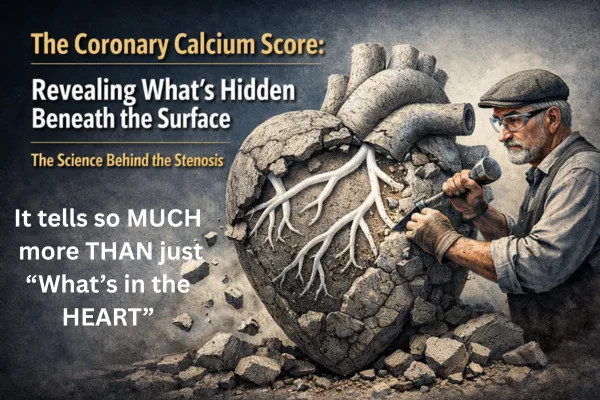
The Coronary Calcium Score: Revealing the Blind Spot in Modern Heart Care
The Coronary Calcium Score: Revealing the Blind Spot in Modern Heart Care — and What It Tells Us About the Metabolic Terrain of the Entire Body
Summary: Why This Changes How We Think About Heart Disease
Most people believe heart disease is about cholesterol numbers, blocked arteries, and stress tests. But the reality is far more complex. Low cholesterol does not automatically mean low risk, and high cholesterol does not automatically mean high risk. What truly determines risk is the underlying biological terrain: inflammation, insulin resistance, metabolic flexibility, vascular health, and how the body repairs itself over time.
This article explains why the coronary calcium score is one of the most powerful tools in modern medicine. It doesn’t estimate risk, it shows whether plaque already exists. In fact, even a calcium score of 1 reflects advanced plaque biology, meaning the disease process has already been active long before symptoms appear. Percentiles help reveal whether this reflects a widespread inflammatory “cobblestone street” problem or a single isolated issue.
You’ll learn why a normal stress test or acceptable cholesterol can be misleading… why imaging often delivers better information with less radiation than people realize… why a zero calcium score often means medication is not needed… and why simply prescribing low-dose statins without identifying disease or biology misses the real opportunity for prevention.
Most importantly, you’ll discover why cardiovascular health mirrors whole-body metabolic health, and why correcting terrain matters more than chasing numbers or percent blockage.
If you want clarity about your real health, this article will change how you think about prevention.
Article
For decades, cardiovascular prevention has been built on indirect measurements. Cholesterol numbers, blood pressure readings, glucose levels, family history, and stress testing have been used to estimate risk rather than directly observe disease. These tools are not useless, but they are surrogates. They attempt to predict what might happen instead of showing what is already happening inside the body.
The Coronary Artery Calcium (CAC) score changes that paradigm. Instead of guessing risk, CAC imaging directly visualizes calcified plaque inside the coronary arteries. It answers the most clinically meaningful question in prevention:
Is coronary artery disease already present?
A calcium score of zero carries an exceptionally low short- and intermediate-term risk of myocardial infarction and cardiovascular mortality across multiple long-term outcome studies.¹–³ When calcium is present, however, it confirms that atherosclerosis has already begun. At that point, a patient is no longer simply “at risk”, disease biology is already active. This distinction matters because medicine should treat disease, not probability models.
From a pathological standpoint, even a calcium score of 1 reflects a Type V fibroatheroma, meaning the plaque has already progressed through inflammatory cell infiltration, lipid accumulation, and soft plaque formation before calcification becomes visible. In practical terms, calcium represents one of the final stages of plaque evolution , not the beginning of disease.
In other words, the biological fire is already burning, and it is far easier to put out a fire early than to wait until it consumes the structure.
Yet many patients are told, “It’s not bad, let’s just watch it,” as if disease becomes easier to reverse with time. That logic is like ignoring a small fire in a toaster oven and waiting until the kitchen, or half the house, is burning before taking action. The goal of preventive medicine is not to wait for catastrophe, but to intervene while biology remains modifiable.
Early intervention does not automatically mean medication, but it absolutely means action.
The art of medicine is identifying the underlying metabolic terrain and biological drivers of atherosclerosis and addressing them upstream through targeted nutrition, movement, stress regulation, sleep optimization, social connection, and meaning-centered living, so that downstream disease expression can be favorably altered even once early plaque has already formed.
Yet the calcium score does far more than simply confirm whether plaque exists. When interpreted correctly, it becomes a window into the deeper biological terrain shaping the entire body.
Percentiles, Biology, and Why Risk Exists on a Continuum
A calcium score should never be interpreted in isolation. Its meaning depends heavily on how the value compares with others of the same age and sex. Percentile ranking restores this context and often reveals risk that raw numbers hide. Population data from the Multi-Ethnic Study of Atherosclerosis (MESA) demonstrate that many younger adults and women maintain a median CAC of zero well into midlife, making any detectable calcium in those groups biologically significant.⁴ Many of us have patients in their 60's, 70's and even 80's with total cholesterol over 300 with NO evidence of calcium... no hardening of the arteries (even on CTA which is geared to even "soft" plaque).
Cholesterol is not disease, plaque is...
When an individual falls into the top 25th percentile for age and gender, this represents a meaningful biological signal, not a hard cutoff, but part of a continuum. The higher the percentile, the more likely it is that vascular aging is being accelerated by an adverse metabolic and inflammatory environment. Percentiles reflect probability of terrain dysfunction, not simply statistical rank.
The higher someone ranks in their age and gender percentile, the more likely this reflects a widespread inflammatory problem in the blood vessels, what I often describe as a “cobblestone street” rather than a single "speed bump". Instead of one small local issue, such as high blood pressure, smoking, a minor injury to a vessel, or a bend in an artery, the entire roadway is becoming rough, irritated, and uneven. When this happens, plaque is more likely to form throughout the system, not just in one spot, because the lining of the blood vessels themselves has changed.
This is a whole-body problem, not just a problem in one small section of an artery.
This pattern is commonly seen in younger individuals and in those with strong family histories of cardiovascular disease. In these populations, even small absolute calcium scores can place someone into a high percentile because most peers have no detectable plaque. The presence of calcium at a young age almost never reflects simple cholesterol exposure alone. It reflects early biological stress, insulin resistance, inflammation, oxidative injury, impaired vascular repair, and metabolic dysfunction operating silently for years before traditional markers appear abnormal.
In older adults, higher absolute scores become more common, but percentile ranking remains clinically meaningful because it reflects relative biological aging rather than chronological age. A seventy-year-old in the ninetieth percentile is biologically very different from a seventy-year-old in the fortieth percentile, even if both technically “have calcium.”
Risk is graded, not binary. The higher the percentile, the stronger the biological signal demanding deeper evaluation.
From Surrogate Risk to Disease Biology
Traditional cardiovascular prevention remains anchored to indirect markers: LDL cholesterol, blood pressure, hemoglobin A1c, stress test performance, and symptom burden. These measurements estimate risk, but they do not explain why disease forms. They do not describe whether arteries are inflamed, whether the endothelial lining can heal and regenerate properly, whether insulin signaling is distorted, whether oxidative stress is damaging tissues, whether immune activation is chronically elevated, or whether cellular energy systems are functioning efficiently.
As a result, clinicians often manage laboratory targets while the biological environment that created the disease continues to deteriorate underneath.
This gap is not accidental. Cardiology training has historically emphasized anatomy and mechanics, identifying blockages, restoring flow, measuring stenosis, rather than systems biology. Cardiologists are extraordinarily skilled at treating late-stage consequences of disease, yet often insufficiently trained to understand the upstream metabolic and inflammatory forces that caused the disease in the first place. The profession excels at opening arteries, but frequently overlooks why those arteries became diseased.
A clear example of this limitation comes from the EVAPORATE trial (European Heart Journal, August 2020). In this study, patients with established coronary atherosclerosis who were treated with high-intensity statin therapy alone showed a 32% increase in fibrofatty plaque volume over 18 months, even though the plaque became somewhat more stable. In contrast, patients who received the same statin therapy plus high-dose EPA omega-3 experienced a 34% reduction in fibrofatty plaque volume. When patients with coronary disease are asked what they want, the answer is almost always the same: they want their plaque to shrink, not grow. Yet it is remarkable how many patients are never even offered therapies that aim to reduce plaque burden, rather than merely stabilize disease while it continues to progress.
This finding is critically important. It tells us that while statins may stabilize plaque, they do not necessarily reverse the underlying plaque burden or the biological drivers of disease. Meaningful plaque regression and biological remodeling require addressing inflammation, lipid oxidation, membrane biology, metabolic signaling, and vascular repair, not simply suppressing cholesterol production.
In other words, statins alone are not a complete solution. The idea that we can “put statins in the water” and solve cardiovascular disease ignores the complexity of human biology. Atherosclerosis is not a single-lever problem. Treating it effectively requires precision, personalization, and a broader biological strategy, not the medical equivalent of the old-fashioned advice: “Take an aspirin and call me in the morning.”
This creates dangerous downstream behavior in everyday practice. Patients with documented coronary artery disease are often prescribed "low dose or low-intensity" statins simply because their cholesterol levels are “not too high,” despite clear guideline recommendations supporting moderate- to high-intensity therapy in established atherosclerotic disease.⁵,⁶ The implicit assumption becomes that plaque formation is primarily LDL-mediated, when in reality it is often terrain-driven and inflammatory.
If you are taking a low dose of a statin “just to be safe,” or simply because your cholesterol levels are acceptable, it is important to understand this: no major medical society recommends low-intensity statin therapy for patients with documented coronary artery disease. The clinical benefit of statin therapy is driven far more by the percentage reduction in LDL cholesterol achieved, not the final LDL number itself. This principle has been well established in the medical literature for more than 15 years, yet it has still not been consistently translated into everyday clinical practice. The evidence overwhelmingly supports aggressive risk reduction once plaque exists. Yet undertreatment remains common, not because of scientific uncertainty, but because of habit, misinterpretation, and clinical complacency.
This is not conservative medicine... It is BAD medicine.
When plaque exists, the central question is not whether LDL is modestly elevated. The real question is why plaque exists at all.
With established disease, standards of care have evolved precisely because outcomes improve when biology is addressed appropriately. Yet many patients are never told when their care deviates from guideline-supported standards. Instead, decisions are framed as clinical “opinion,” despite little scientific support for under-treating documented disease. In many cases, the emperor truly has no clothes, not out of malice, but because the clinician may not fully understand the evolving biology, and the patient has no way of knowing what is missing.
This asymmetry of knowledge places patients at the mercy of incomplete care, even when that care is well-meaning. It is similar to being sold a used car equipped with only a two-point seatbelt and no airbags, not because the seller intends harm, but because they are unaware that safety standards have evolved. The vehicle appears functional and reassuring, yet it fails to provide the protection modern engineering demands.
Zero Calcium Means No Indication for Statins — Even With High Cholesterol
A critically important, and too often ignored, principle in modern prevention is this: a zero coronary calcium score in an otherwise stable individual generally indicates that pharmacologic lipid therapy is not warranted, even when cholesterol levels are elevated. This reflects contemporary guideline philosophy and outcome data demonstrating that CAC = 0 identifies individuals with extremely low near-term cardiovascular event rates.¹–³
If there is no demonstrable plaque, there is no biological disease target for statin therapy to modify. Prescribing lifelong medication in the absence of documented atherosclerosis exposes patients to potential side effects without proven benefit.
Prevention in this setting should emphasize metabolic optimization, lifestyle physiology, and periodic reassessment, not reflexive pharmacology.
Even in so-called “high-risk” individuals with elevated cholesterol, a zero calcium score should prompt thoughtful surveillance with repeat imaging in approximately three to five years, rather than immediate medication. The priority should be improving metabolic terrain and biological resilience, not medicating laboratory numbers.
Yet many clinicians still have a knee-jerk reflex to prescribe statins based purely on cholesterol numbers despite the absence of disease on imaging. This is fear-based medicine rather than evidence-based medicine. When arteries are clean, medication is not prevention, it is both overtreatment and inappropriate treatment.
Residual Cardiovascular Risk and the Metabolic–Inflammatory Core
Modern cardiovascular science recognizes that even when LDL cholesterol is treated, large amounts of residual cardiovascular risk remain. Inflammation, thrombotic biology, triglyceride metabolism, Lipoprotein(a), and insulin resistance continue to drive events despite optimal LDL lowering.⁷,⁸
In real-world biology, particularly in younger patients and those with genetic predisposition, these factors frequently converge into a dominant upstream driver: insulin resistance and chronic low-grade inflammation.
This metabolic-inflammatory state accelerates endothelial dysfunction, destabilizes plaque, impairs vascular repair, disrupts mitochondrial efficiency, and increases thrombogenic signaling long before symptoms appear.
This is not speculative. Jesús and colleagues demonstrated that many patients presenting with established coronary artery disease had previously unrecognized diabetes or abnormal glucose metabolism, confirming that metabolic dysfunction often precedes cardiovascular disease by many years.⁹
The science is not missing... the application is.
Functional Stress Testing: Shrinking Value in a Precision Era
Functional stress testing was developed in an era before advanced coronary imaging existed. These tests still have value in select scenarios, such as evaluating exercise tolerance or symptomatic ischemia. However, they do not visualize plaque and do not characterize early biological risk.
A stress test can be entirely normal despite substantial plaque burden, vascular inflammation, and metabolically unstable terrain. Patients are often falsely reassured while disease quietly progresses. Comparative trials demonstrate that CTA identifies coronary disease more effectively than functional testing.¹⁰
Radiation Perspective, Putting Risk in Context
Radiation exposure is frequently misunderstood. To place imaging exposure into perspective, a standard screening mammogram delivers approximately 0.4 mSv of radiation.
A modern low-dose coronary calcium scan typically delivers approximately 0.5–1.5 mSv, which is roughly equivalent to about 1–4 mammograms, and often closer to 1–2 mammograms on contemporary scanners.
A modern coronary CTA typically delivers approximately 1–3 mSv, or roughly 3–8 mammograms, depending on scanner technology and protocol.
In contrast, many traditional nuclear stress tests (SPECT myocardial perfusion imaging) commonly expose patients to approximately 9–14 mSv or more, which is equivalent to roughly 20–35 mammograms, and in many real-world labs still exceeds 10–20 mammogram equivalents.¹¹
Despite this substantially higher radiation burden, nuclear testing continues to be ordered reflexively in many environments, often delivering more radiation with less actionable biological information. In many patients, nuclear stress testing is repeated annually without adequate consideration of cumulative lifetime radiation exposure.
There is also an uncomfortable economic reality. Historically, stress testing revenue has been embedded within cardiology practice models. Advanced imaging shifts financial revenue away from cardiology practices and into radiology departments, moving procedural profit out of the cardiologist’s pocket and into the radiologist’s. While this financial realignment is rarely discussed openly, it inevitably influences ordering behavior and resistance to change. The patient, however, should not bear the cost of outdated economic models.
Stress testing still has a role, but its dominance as a frontline screening tool for biological risk is appropriately shrinking.
CTA: The True Gold Standard — With a Life-Saving Bonus
While CT Coronary Calcium Score is an excellent screening tool, the gold standard for coronary evaluation is Coronary CT Angiography (CTA). CTA builds upon calcium scoring by adding intravenous contrast, allowing direct visualization of both calcified and non-calcified plaque, coronary anatomy, plaque characteristics, and vessel narrowing, exponentially expanding the depth and clinical value of the information obtained.
CTA visualizes calcified and non-calcified plaque, assesses plaque morphology and vulnerability, evaluates stenosis severity, and maps coronary anatomy with precision.¹²
An underappreciated advantage of both CAC and CTA over Stress testing is lung visualization. Over years of clinical practice, I have personally identified more than 25 asymptomatic early lung cancers incidentally on CTA scans, all detected early and curable. Opportunistic lung assessment on cardiac CT is increasingly recognized as a meaningful secondary benefit.¹³
CTA is not simply cardiac imaging... it is systemic surveillance.
Why CAC Remains the Most Accessible Entry Point
Despite CTA’s superiority, CAC remains invaluable because of its simplicity and accessibility. A calcium scan requires no intravenous contrast, no IV placement, minimal radiation exposure, no special preparation, and typically costs approximately $100–$150. In most regions, it does not require prior authorization, insurance approval, or complex scheduling. It can be ordered directly by a primary care clinician through a radiology center, often as easily as requesting a routine chest X-ray.
Because CAC bypasses many of the bureaucratic barriers that slow traditional testing, it empowers patients and clinicians to obtain meaningful information quickly and efficiently. This accessibility removes excuses for delay, indecision, or over-reliance on indirect testing when a simple scan can clarify whether disease is present. In many cases, patients can simply email or call their primary care physician to request that the referral be sent directly to the imaging center, without needing an office visit first, and then review the results together at their next scheduled appointment.
A cardiology referral should become appropriate after disease is identified, not as a prerequisite for screening. When a provider insists that a patient must see a cardiologist first simply to obtain a calcium score, it often reflects outdated practice patterns and unfamiliarity with current evidence and guidelines. That, in itself, should raise concern regarding competency. Modern preventive medicine prioritizes timely, accurate diagnosis, not unnecessary gatekeeping.
If coronary disease is present, cardiology involvement is absolutely appropriate. But delaying simple, low-risk screening behind administrative hurdles serves neither patients nor science. In preventive care, clarity should precede complexity.
Cardiovascular Health Is a Microcosm of Metabolic Health
Here is the deeper truth modern medicine often misses:
Cardiovascular health is a microcosm of overall metabolic health, meaning it is a small but powerful reflection of how the entire body’s metabolism is functioning.
The same biological forces that damage coronary arteries, insulin resistance, inflammation, oxidative stress, mitochondrial dysfunction, immune dysregulation, also drive fatty liver disease, kidney dysfunction, neurodegeneration, cancer risk, frailty, and accelerated aging.
Mechanically treating arteries with stents or bypass surgery does not correct the metabolic terrain that created the disease. It restores blood flow locally but does not repair the biological drivers of chronic disease. Without terrain correction, risk simply migrates elsewhere.
Fixing plumbing is not restoring biology.
Clinical Call to Action
If you have metabolic risk factors, including high cholesterol or family history of heart disease, do not rely on a normal stress test as reassurance.
If you have never had a calcium score, you deserve to know what your arteries reveal. Knowledge is power and drives precision.
If your CAC places you in higher percentiles, this is not reassurance or just about heart disease, it is a signal to evaluate your cardiometabolic terrain early.
If you already have documented coronary disease, low-intensity therapy based on “acceptable cholesterol” is not evidence-based medicine.
The coronary calcium score does more than detect plaque.
It reveals the biological environment that created it.
At CardioCore, we do not manage numbers... We decode biology.
Author: Dr John Sciales
Director, CardioCore Metabolic Wellness Center
"Getting to the Core- where being Healthy is Not an Accident"
Click here to book a discovery call
Click here to join our private community
Click here to speak with our CardioMetabolic virtual assistant
References
Blaha MJ, et al. Absence of coronary artery calcification and all-cause mortality. JACC Cardiovasc Imaging. 2009.
Valenti V, et al. Long-term prognosis after CAC = 0. JACC. 2011.
Nasir K, et al. Role of CAC in cardiovascular risk prediction. Circulation. 2012.
McClelland RL, et al. MESA CAC reference values by age and sex. JACC. 2009.
Grundy SM, et al. 2018 AHA/ACC Cholesterol Guideline. Circulation. 2019.
Mach F, et al. ESC/EAS Dyslipidemia Guidelines. European Heart Journal. 2019.
Ridker PM, et al. Residual inflammatory risk and CANTOS. NEJM. 2017.
Libby P. Inflammation in atherosclerosis. Nature. 2002.
Jesús M, et al. Real incidence of diabetes mellitus in a coronary disease population. Am J Cardiol. 2013;111(3):333–338.
Douglas PS, et al. PROMISE Trial: CTA vs functional testing. NEJM. 2015.
Einstein AJ, et al. Radiation dose from cardiac imaging. Circulation. 2010.
Budoff MJ, et al. ACCF/SCCT CTA expert consensus. JACC. 2016.
MacMahon H, et al. Incidental pulmonary nodules on CT. Radiology. 2017.
