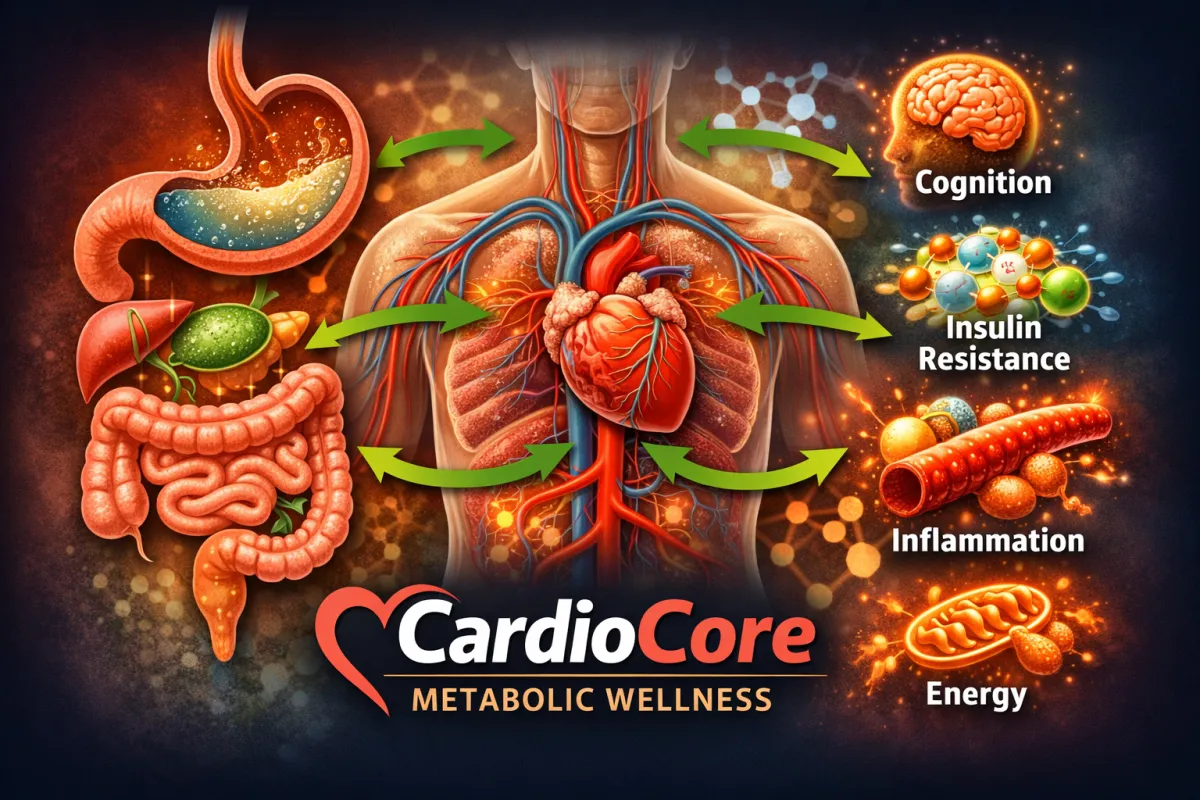
Cardiometabolic Health Starts in the Stomach: The Bidirectional Link Between Gastric Acid, Gut Health, and Metabolic Disease
Cardiometabolic Health Starts in the Stomach:
The Bidirectional Link Between Gastric Acid, Gut Health, and Metabolic Disease
Summary
This may get you sick to your stomach — but the truth is, your stomach may be one of the most overlooked drivers of your metabolic health.
Stomach acid is not just about digestion or heartburn. It is a powerful metabolic signal that influences inflammation, insulin resistance, energy production, cognition, and cardiovascular risk. In this article, we explore how suppressing stomach acid can quietly disrupt the gut microbiome, weaken immune defenses, and fuel cardiometabolic disease — and why true prevention starts where digestion begins.
The Overlooked Connection Between Digestion and Cardiometabolic Health
When people think about heart disease, diabetes, or metabolic syndrome, they usually think about cholesterol, blood sugar, or blood pressure. Very few think about digestion. Yet one of the most commonly used categories of medication in the United States is for acid reflux.
Proton pump inhibitors (PPIs) such as omeprazole and esomeprazole, H2 blockers like famotidine, and over-the-counter antacids are taken daily by millions of people, often for years. These medications are generally used to suppress stomach acid, based on the belief that heartburn and reflux are caused by “too much acid.” For many people, however, the issue is not excess acid, but impaired digestion and disrupted metabolic signaling that begins in the stomach and extends throughout the body.¹²
From a cardiometabolic standpoint, this matters deeply. Chronic inflammation, insulin resistance, vascular dysfunction, and impaired energy production are not isolated problems. They are part of a connected biological system, and the digestive tract plays a central role in regulating that system. Quality bowel health does not begin in the colon. It begins in the stomach, where digestion, immune defense, and metabolic signaling are first activated.³
Why the Stomach Is Designed to Be Highly Acidic
A healthy stomach is one of the most acidic environments in the human body, with a normal pH between approximately 1.5 and 3.0. This level of acidity is strong enough to denature proteins and kill many ingested pathogens.⁴ The stomach is protected by a mucus-bicarbonate barrier and tight epithelial junctions that prevent self-digestion. This powerful acid environment is maintained because it is essential for digestion, nutrient bioavailability, and immune defense, not because it is harmful.⁵
When gastric acidity is reduced, bacterial survival increases, protein digestion becomes incomplete, and downstream digestive signaling is impaired.⁶
Protein Digestion, Pepsin, and Inflammatory Signaling
Protein digestion begins in the stomach. Chief cells release pepsinogen, which is converted to the active enzyme pepsin only in an acidic environment. Pepsin initiates protein breakdown into smaller peptides that can later be fully digested and absorbed in the small intestine.⁷ Without sufficient acid, pepsin activation is reduced and large protein fragments pass into the intestine.
These undigested proteins can promote bacterial overgrowth and stimulate immune responses in the gut mucosa.⁸ Dysbiosis and immune activation increase production of pro-inflammatory cytokines, which contribute to systemic inflammation and insulin resistance.⁹ This links impaired protein digestion directly to metabolic dysfunction.
The Gut Lining, Immune Activation, and Increased Intestinal Permeability
The intestinal lining is designed to allow nutrient absorption while preventing entry of pathogens and antigenic food particles. Tight junction proteins regulate this barrier function. When inflammation disrupts these junctions, permeability increases, allowing bacterial endotoxins and food antigens to enter circulation.¹⁰
This immune activation drives chronic low-grade inflammation, which has been strongly linked to insulin resistance, endothelial dysfunction, and progression of atherosclerosis.¹¹¹² Thus, gut barrier dysfunction originating from impaired digestion contributes to cardiometabolic disease progression.
At its most basic level, the gastrointestinal tract is a roughly 24-foot-long tube running from mouth to rectum. Medical students have long joked that digestion is simply “a tube two-thirds full of… well, you get the idea.” Even the old medical definition of a kiss drives the point home: "Sucking on one end of a 24-foot tube, 2/3 full of Poop"... although they used a much more descriptive word.
Crude? Yes. But biologically accurate.
Because everything inside that tube is technically outside the body until it crosses the gut lining. And when digestion fails upstream, what crosses that barrier isn’t just nutrients — it’s inflammation.
Stomach Acid as the Signal for Pancreas and Bile Function
When acidic chyme enters the duodenum, it stimulates release of secretin and cholecystokinin, hormones that trigger pancreatic enzyme secretion and bile release from the gallbladder.¹³ These secretions are required for digestion and absorption of fats, proteins, and carbohydrates.
If gastric acid is suppressed, this hormonal signaling is reduced, leading to impaired enzyme and bile release, fat malabsorption, and deficiencies in fat-soluble vitamins.¹⁴ Vitamin D deficiency, in particular, has been associated with insulin resistance, immune dysregulation, and cardiovascular disease risk.¹⁵
The Microbiome, Energy, and Brain Function
The gut microbiome plays a central role in regulating immune tolerance, glucose metabolism, and even neurotransmitter synthesis. Dysbiosis promotes systemic inflammation through endotoxin translocation and altered short-chain fatty acid production.¹⁶
Microbial metabolites influence brain signaling via the gut-brain axis, affecting cognition, mood, and stress response.¹⁷ Since chronic stress and neuroinflammation worsen insulin resistance and cardiovascular risk, microbiome disruption becomes another pathway linking digestion to cardiometabolic disease.
Why Reflux Is Often a Sign of Weak Digestion, Not Excess Acid
Gastroesophageal reflux can result from delayed gastric emptying and increased intra-abdominal pressure rather than excessive acid production.¹⁸ Hypochlorhydria may impair gastric motility and promote fermentation, gas production, and reflux symptoms.¹⁹
Acid suppression may reduce symptoms temporarily but can worsen digestive inefficiency and microbial imbalance over time, perpetuating dependence on medication.
Acid-Suppressing Medications and Long-Term Metabolic Risk
Long-term PPI use has been associated with vitamin B12 deficiency, magnesium deficiency, increased fracture risk, bacterial overgrowth, and altered microbiome composition.²⁰²¹ PPI-induced dysbiosis has been linked to increased systemic inflammation and metabolic dysfunction.²²
While these medications are effective for short-term treatment of ulcers and erosive disease, chronic use without addressing root causes of digestive impairment may contribute to progressive metabolic decline.
The Bidirectional Nature of Gut and Metabolic Disease
Insulin resistance, obesity, and chronic stress impair digestive function through autonomic nervous system imbalance and reduced splanchnic blood flow.²³ At the same time, digestive dysfunction promotes inflammation and metabolic deterioration. This creates a self-reinforcing cycle between gastrointestinal pathology and cardiometabolic disease.
Breaking this cycle requires addressing digestion, inflammation, insulin resistance, and stress physiology together rather than managing symptoms in isolation.
Why Cardiometabolic Prevention Must Start Upstream
Modern cardiometabolic prevention focuses largely on downstream markers such as LDL cholesterol and fasting glucose. However, upstream drivers such as gut inflammation, nutrient malabsorption, microbiome disruption, and immune activation often precede measurable laboratory abnormalities.²⁴
Supporting gastric physiology, digestive signaling, and gut barrier integrity can reduce inflammatory burden, improve insulin sensitivity, and enhance metabolic flexibility — all central goals of cardiovascular prevention.
You’d Have to Be an "A#S" Not to Pay Attention
Stomach acid is a fundamental metabolic signal and immune defense mechanism. When it is chronically suppressed without addressing underlying digestive dysfunction, inflammation and metabolic instability may worsen over time. Reflux is often not an isolated gastrointestinal complaint but an early warning sign of broader metabolic imbalance.
True cardiometabolic wellness requires systems-based thinking. And in the digestive system, that system begins in the stomach.
Cardiometabolic health starts there.
Yes , The “A#S” Really Is in Charge
We’ve all said it at work.
When things are dysfunctional, slow, or falling apart, someone eventually mutters,
“Well… the A#S is in charge.”
Here’s the uncomfortable truth:
In your body, that may actually be true.
But not in the way you think.
Cardiometabolic health is not determined by what happens at the end of the digestive tract. It’s determined by what happens at the beginning — in the stomach, where acid triggers digestion, immune defense, microbiome balance, enzyme release, bile flow, and metabolic signaling. When that system breaks down, inflammation rises, insulin resistance follows, energy declines, cognition suffers, and cardiovascular risk quietly accelerates.
Most people focus on symptoms.
Most medicine focuses on suppression.
Very few ask why digestion failed in the first place.
At CardioCore Metabolic Wellness, that’s exactly where we start.
We don’t treat reflux as a nuisance.
We don’t see gut issues as isolated GI problems.
We look at the entire cardiometabolic terrain — digestion, inflammation, insulin resistance, hormones, microbiome health, and vascular risk — because that’s how real prevention and recovery actually happen.
If you’re tired of managing symptoms, popping pills, and being told everything is “normal” while your energy, focus, and metabolic health quietly decline, it’s time for a different approach.
This isn’t just about your rectum. It starts at the top and ends up where you poop !!!
It’s about your metabolism, your heart, your brain, and your future.
If you’re ready to understand what’s really driving your inflammation, insulin resistance, and cardiometabolic risk — and to address it at the root — CardioCore Metabolic Wellness is here to help.
Because when it comes to your health, the “A#S” may be in charge — but you don’t have to let it run the entire company.
Author: Dr John Sciales
Director, CardioCore Metabolic Wellness Center
"Getting to the Core- where being Healthy is Not an Accident"
Click here to book a discovery call
Click here to join our private community
Click here to speak with our CardioMetabolic virtual assistant
REFERENCES
Heidelbaugh JJ, Kim AH, Chang R, Walker PC. Overutilization of proton-pump inhibitors: what the clinician needs to know. Ther Adv Gastroenterol. 2012;5(4):219–232.
Scarpignato C, et al. Effective and safe proton pump inhibitor therapy in acid-related diseases. BMC Med. 2016;14:179.
Tilg H, Moschen AR. Microbiota and diabetes: an evolving relationship. Gut. 2014;63(9):1513–1521.
Evans DF, et al. Measurement of gastrointestinal pH profiles in normal ambulant subjects. Gut. 1988;29(8):1035–1041.
Allen A, Flemström G. Gastroduodenal mucus bicarbonate barrier. Physiol Rev. 2005;85(4):1215–1252.
Martinsen TC, Bergh K, Waldum HL. Gastric juice: a barrier against infectious diseases. Basic Clin Pharmacol Toxicol. 2005;96(2):94–102.
Richter C, et al. Regulation of pepsinogen secretion. Physiol Rev. 1980;60(1):1–56.
Quigley EM. Gut bacteria in health and disease. Gastroenterology & Hepatology. 2013;9(9):560–569.
Hotamisligil GS. Inflammation and metabolic disorders. Nature. 2006;444:860–867.
Camilleri M, et al. Intestinal barrier function in health and gastrointestinal disease. Neurogastroenterol Motil. 2012;24(6):503–512.
Cani PD, et al. Metabolic endotoxemia initiates obesity and insulin resistance. Diabetes. 2007;56(7):1761–1772.
Libby P. Inflammation in atherosclerosis. Nature. 2002;420:868–874.
Chey WY, Chang T. Neural hormonal regulation of exocrine pancreatic secretion. Pancreas. 1984;1(4):320–335.
DiBaise JK, et al. Small intestinal bacterial overgrowth: roles of antibiotics, prebiotics, and probiotics. Gastroenterology. 2008;134(6):S23–S30.
Pittas AG, et al. Vitamin D and risk of type 2 diabetes. J Clin Endocrinol Metab. 2007;92(6):2017–2029.
Tilg H, Kaser A. Gut microbiome, obesity, and metabolic dysfunction. J Clin Invest. 2011;121(6):2126–2132.
Cryan JF, Dinan TG. Mind-altering microorganisms: the gut-brain axis. Nat Rev Neurosci. 2012;13(10):701–712.
Tack J, Pandolfino JE. Pathophysiology of gastroesophageal reflux disease. Gastroenterology. 2018;154(2):277–288.
McCallum RW, et al. Delayed gastric emptying in reflux disease. Am J Gastroenterol. 1983;78(7):438–442.
Lam JR, et al. Proton pump inhibitor and histamine-2 receptor antagonist use and vitamin B12 deficiency. JAMA. 2013;310(22):2435–2442.
Yang YX, et al. Long-term proton pump inhibitor therapy and risk of hip fracture. JAMA. 2006;296(24):2947–2953.
Imhann F, et al. Proton pump inhibitors affect the gut microbiome. Gut. 2016;65(5):740–748.
Thayer JF, Lane RD. Claude Bernard and the heart–brain connection. Neurosci Biobehav Rev. 2009;33(2):81–88.
DeFronzo RA, Ferrannini E. Insulin resistance: a multifaceted syndrome. Diabetes Care. 1991;14(3):173–194.
